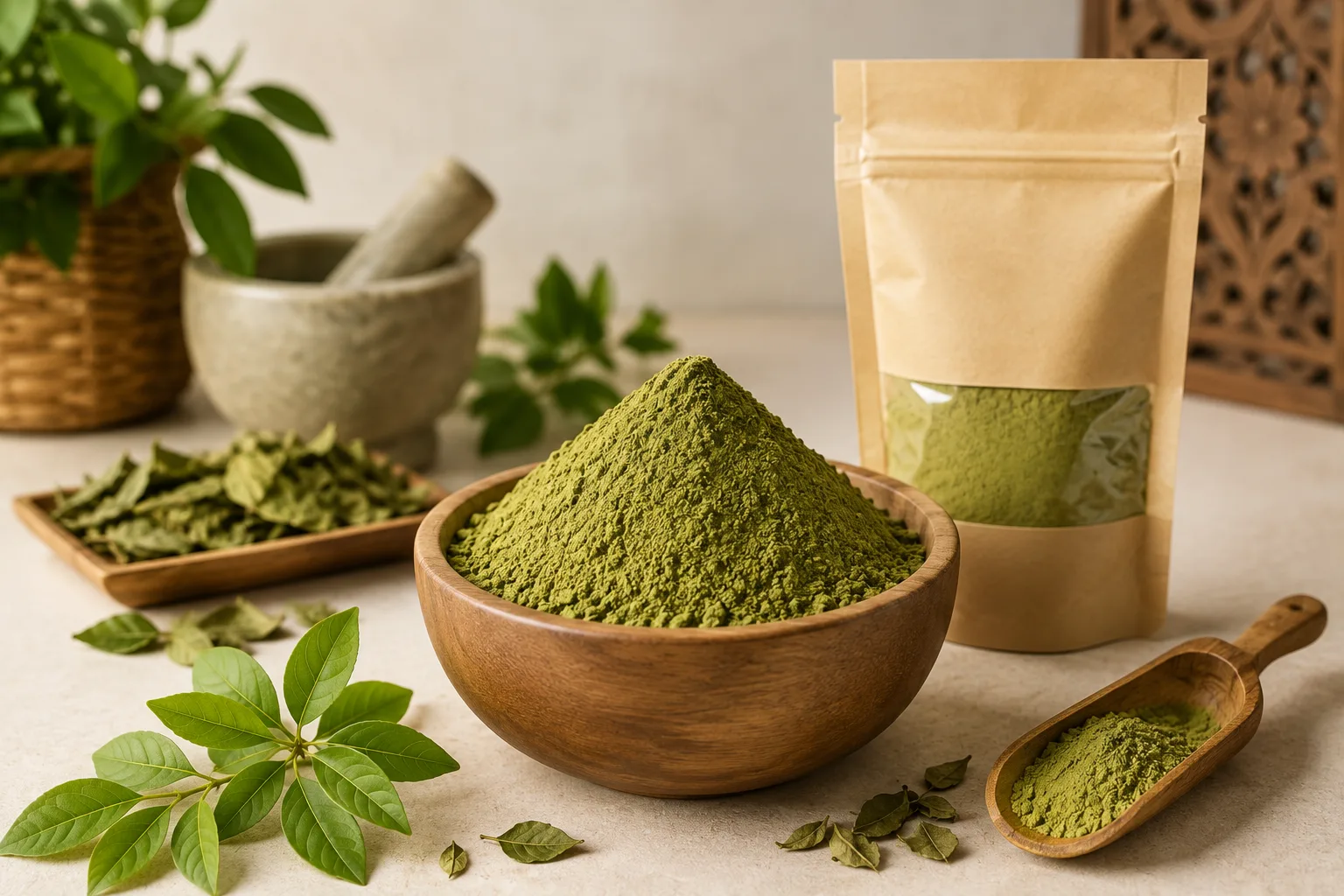
Two powders may look almost identical, yet differ significantly in texture, processing, purity, consistency and suitability for different applications. This becomes even more important when henna is being purchased for salons, cosmetic brands, wholesale distribution, private labeling or export.
One of the biggest mistakes buyers make is assuming that the brightest green henna powder must be the best.
In reality, high-quality henna should be evaluated through a combination of sourcing, processing, fineness, cleanliness, aroma, packaging and batch consistency.
For buyers looking for naturally sourced henna from Rajasthan, Maru Henna works with henna sourced from Sojat and supplies natural henna for retail as well as wholesale, private-label and export requirements.
Before judging quality, identify what you are actually buying henna for.
Different applications can require different product characteristics.
Natural henna powder is produced from the leaves of Lawsonia inermis. It is commonly used for natural hair colouring, traditional mehndi and herbal cosmetic applications.
A good natural henna powder should have a fine texture, characteristic herbal aroma and appropriately processed plant material.
Henna intended primarily for hair applications should mix into a smooth, manageable paste and provide consistent colouring performance.
For businesses manufacturing herbal hair-care products, repeat-batch consistency becomes particularly important.
Henna intended for detailed mehndi applications generally benefits from very fine processing because a smoother paste can be easier to work with for intricate designs.
Buyers should pay particular attention to fineness, filtration and cleanliness.
Some commercial products combine henna with other botanical ingredients for specific hair-care or cosmetic formulations.
These should not automatically be treated as equivalent to pure single-ingredient henna powder.
Always check the complete ingredient declaration.
For wholesalers, distributors and cosmetic brands, quality involves more than the powder itself.
Businesses should evaluate:
This is particularly important when choosing a long-term henna manufacturer rather than purchasing a single retail pack.
Natural henna powder commonly ranges from green to olive-green.
Its exact shade can vary because of growing conditions, harvesting, drying, processing, storage and the age of the material.
Therefore:
Bright green ≠ automatically high quality.
An unnaturally vivid appearance should not be used as proof of purity or freshness.
Instead, look for reasonably consistent natural-looking colour and evaluate it together with texture, aroma, cleanliness and supplier information.
Take a small amount of dry henna between clean fingers.
Henna intended for smooth paste preparation should generally feel finely processed rather than obviously coarse or gritty.
Look for unwanted characteristics such as:
For professional buyers, ask the manufacturer about milling, filtration and sieving rather than relying on marketing terms such as “super fine.”
Natural henna has a characteristic herbal, earthy or plant-like aroma.
The exact smell can vary, so aroma should not be treated as a scientific purity test.
However, an unexplained strong perfume-like or unusual chemical odour deserves further investigation.
When comparing suppliers, smell different samples under similar conditions.
Here's a very simple preliminary quality check.
Place a small amount of henna powder on a clean white sheet or plate and spread it into a thin layer.
Look for:
This does not replace laboratory testing, but it can help identify obvious differences between supplier samples.
Don't approve henna based on the dry powder alone.
Prepare small test batches from the suppliers you are evaluating.
The important word here is controlled.
Use the same quantity of powder, same preparation method and same evaluation process for every sample.
Then compare:
Smoothness → Mixing → Texture → Application → Performance
If one sample is tested differently from another, the comparison becomes less meaningful.
Raw-material sourcing is an important part of henna quality.
Sojat in Rajasthan is strongly associated with India's henna-growing and processing industry.
However, simply writing “Sojat Henna” on packaging should not be enough for a commercial buyer.
Ask:
Where are the leaves sourced?
Where is the powder processed?
How is the raw material selected?
How is it dried and stored?
Can batches be identified?
Maru Henna states that its natural henna is sourced from Sojat, Rajasthan and processed through stages including cultivation, harvesting, drying, fine grinding and hygienic packaging.
High-quality finished henna depends heavily on what happens before the powder reaches its packaging.
A typical process may involve:
Henna cultivation → harvesting → drying → cleaning → grinding → sieving/filtering → quality checks → packaging → storage
Every stage matters.
Poor storage can expose the material to moisture.
Inconsistent grinding can affect texture.
Inadequate cleaning can leave unwanted plant material.
Weak packaging can affect the product during transportation and storage.
This is why serious B2B buyers should evaluate the manufacturing process rather than comparing products only by price.
A perfect sample does not automatically mean you have found the right supplier.
For commercial buyers, consistency is quality.
Imagine receiving:
Sample: Excellent
First order: Excellent
Second order: Acceptable
Third order: Completely different texture
Even though the original sample was impressive, the supplier has failed one of the most important B2B requirements: repeatability.
Wholesalers, salons, cosmetic manufacturers and private-label brands should therefore evaluate batch-to-batch consistency whenever possible.
Good henna can deteriorate when handled or stored poorly.
Henna powder should generally be protected against environmental factors such as:
Packaging becomes even more important for bulk and export shipments because products may spend considerably longer in storage and transit.
A supplier should therefore be evaluated on both:
Henna quality + packaging capability
For a personal purchase, examining ingredients and product information may be sufficient.
For commercial sourcing, more detailed information may be necessary.
Depending on the intended market and product requirements, businesses can ask about:
Documentation should also correspond to the actual product or batch wherever applicable.
|
Look For |
Be Careful With |
|
Natural-looking appearance |
Extremely artificial-looking colour |
|
Fine, consistent texture |
Excessive coarse particles |
|
Characteristic herbal aroma |
Unexplained chemical-like odour |
|
Clear sourcing information |
Vague origin claims |
|
Controlled processing |
No manufacturing information |
|
Batch traceability |
No batch information |
|
Suitable packaging |
Poor moisture protection |
|
Consistent repeat supply |
Quality changing every order |
|
Clear specifications |
Marketing claims without details |
This distinction is important.
Focus primarily on:
Ingredients + intended use + product quality + preparation instructions + packaging
You may only need a relatively small quantity, so large-scale manufacturing capability matters less.
Your checklist becomes much bigger.
You need:
Product quality + batch consistency + reliable supply + specifications + packaging + documentation + manufacturing capability + communication
If you are building your own herbal beauty brand, you may additionally need private-label manufacturing and customized packaging.
For businesses searching for a henna manufacturer, wholesale supplier or private-label partner, Maru Henna is based in Sojat, Rajasthan and works with natural henna sourced from the region.
The company provides solutions for different buyer categories, including:
Its offerings include natural/herbal henna powder, bulk supply, customized packaging, private-label support and export-oriented solutions.
For retail requirements, buyers can explore natural henna products.
For B2B requirements, wholesalers and brands can enquire about bulk supply, customized packaging, private labeling and export solutions.
Suppose Supplier A offers henna slightly cheaper than Supplier B.
Initially, Supplier A appears to be the obvious choice.
But what happens if:
The “cheaper” supplier can quickly become the more expensive option.
For businesses, supplier value should therefore be calculated as:
Quality + Consistency + Reliability + Service + Price
—not price alone.
There is no single visual trick that proves henna quality.
Not colour.
Not smell.
Not a “premium” label.
Not even geographic origin by itself.
A better evaluation considers the complete journey:
Raw Material → Sourcing → Processing → Fineness → Cleanliness → Performance → Packaging → Documentation → Batch Consistency
For individual buyers, this helps you make a more informed product choice.
For businesses, it helps you identify suppliers capable of supporting your brand over the long term.
If you're sourcing natural henna powder, Sojat henna, wholesale henna or private-label henna, evaluate a representative sample before committing to a major purchase.
For natural henna sourced from Sojat, Rajasthan, along with retail, wholesale, private-label and export-oriented supply options, visit: https://maruhenna.in/
Evaluate several characteristics together: sourcing, appearance, texture, aroma, cleanliness, processing, packaging and practical performance. Business buyers should additionally check documentation and batch consistency.
Natural henna commonly ranges between green and olive-green, but shade can vary depending on raw material, harvesting, processing, storage and age.
No. Colour alone cannot prove purity, freshness or quality.
Natural Lawsonia inermis henna is widely used for hair colouring and traditional hair-care applications. Buyers should check ingredients and choose a product specifically intended for their desired use.
The botanical ingredient may be the same, but processing requirements and desired powder characteristics can differ according to the intended application. Fine processing is particularly useful where a very smooth paste is required.
Sojat, Rajasthan, has a long-established association with henna cultivation and processing. Buyers should still evaluate the individual manufacturer, processing methods and product specifications rather than relying on geographic origin alone.
Maru Henna supplies natural henna sourced from Sojat, Rajasthan for retail as well as commercial requirements.
Does Maru Henna supply henna in bulk?
Yes. Maru Henna provides bulk and wholesale supply options for distributors, retailers, salons, cosmetic businesses and other commercial buyers.
Yes. Private-label and customized packaging solutions are available for businesses looking to sell henna under their own brand.
Maru Henna provides export-oriented supply and packaging solutions for international buyers.