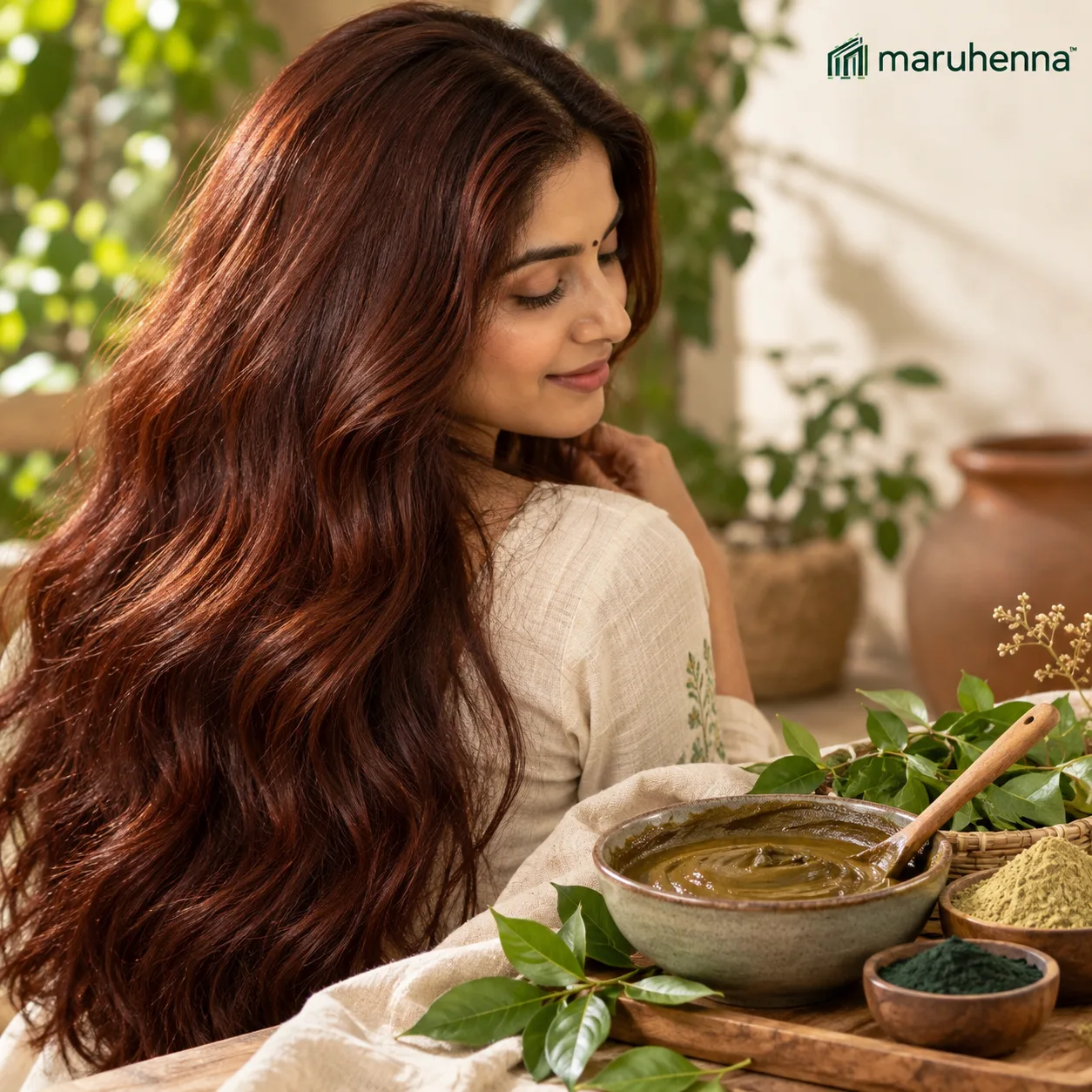
Henna can create beautiful copper, auburn, red and reddish-brown tones on hair, but getting a deep, rich result depends on much more than simply mixing henna powder with water and applying it.
The quality of the henna, your starting hair colour, how the paste is prepared, how evenly it is applied and how long the colour is allowed to develop can all influence the final shade.
This is especially important for people with grey or light hair, where henna tends to appear much brighter than it does on naturally dark hair.
If your henna result looks lighter, brighter or more orange than expected, there are several ways to improve the colour naturally without relying on unknown additives or harsh colouring chemicals.
This guide explains how to get darker henna colour on hair, what actually influences the result and what you should realistically expect from pure henna.
Natural henna comes from the leaves of Lawsonia inermis. Its main colouring molecule, lawsone, interacts with keratin in the hair and deposits a warm orange-red pigment.
Unlike conventional oxidative hair colour, henna does not bleach away your natural hair pigment. Instead, its colour combines visually with your existing shade.
That is why the same henna can look very different on different people.
Pure henna commonly produces:
Copper or orange-red on white and grey hair
Copper-red or auburn on lighter brown hair
Reddish-brown tones on medium brown hair
Subtle warm or red reflections on dark brown and black hair
If you are new to botanical colouring, our detailed guide to henna powder for skin and hair explains how natural henna works and what it can realistically do.
One of the biggest factors affecting henna colour is the quality of the powder itself.
Fresh, properly processed henna generally produces a more dependable dye release than material that has been poorly stored, exposed to excessive moisture or kept for too long under unsuitable conditions.
A good henna powder should usually:
Have a natural herbal or earthy aroma
Mix into a reasonably smooth paste
Be finely processed
Have clear ingredient information
Be stored in suitable, moisture-protected packaging
Do not judge henna purely by how bright green the powder appears. Colour alone is not a reliable measure of quality.
If you want to evaluate a product before use, read our guide on how to identify high-quality henna powder.
You can also explore Maru Henna's natural henna powder and essential oil collection for retail and larger-use requirements.
One of the most common reasons people feel their henna is “not dark enough” is that they expect the same result regardless of their natural hair colour.
Henna is translucent.
It adds pigment over the colour already present in your hair rather than replacing it completely.
For example, someone with white hair may initially get a strong copper result, while the same henna on dark brown hair may only create warm reddish highlights.
This becomes particularly noticeable on grey hair.
If grey coverage is your main concern, our dedicated guide on using henna powder for grey hair explains expected shades, application considerations and darker botanical colour options in greater detail.
Henna requires moisture and sufficient preparation time for its natural dye to become available.
Place the required henna powder in a clean, non-reactive bowl and gradually add liquid until the mixture reaches a smooth, thick consistency similar to yogurt.
The paste should be:
Smooth enough to spread easily
Thick enough to stay on the hair
Free from dry lumps
Consistent throughout
Extremely hot or boiling water is not necessary.
A simple mixture is often easier to control than a complicated recipe containing several ingredients.
After mixing, follow the product's recommended preparation or resting instructions.
Temperature, henna quality and formulation can all affect how quickly dye release occurs, so one fixed resting time does not apply to every product.
Coffee, tea, beetroot, cloves and many other ingredients are frequently recommended online for making henna darker.
Some may temporarily influence the mixture's tone, aroma or texture, but they do not automatically produce dramatically darker or longer-lasting results.
For most users, the fundamentals matter far more:
Quality henna + correct preparation + thorough application + adequate processing + oxidation
Adding too many ingredients can also make it difficult to understand what is actually improving—or worsening—the result.
If you are using henna for the first time, keeping the formulation simple is usually the more practical approach.
Heavy oils, silicone-rich products and styling residues may interfere with even contact between the henna paste and hair.
Before colouring, wash your hair to remove excessive buildup.
You generally do not need to apply a heavy oil treatment immediately before henna.
Clean hair makes it easier to distribute the paste thoroughly from root to tip.
If your hair is chemically treated, bleached, highly porous or previously coloured, perform a strand test first because plant dyes can behave differently on previously processed hair.
Application technique can have a major impact on the final result.
Instead of applying henna randomly across the hair, divide it into manageable sections.
Work systematically and make sure the paste fully covers:
New growth
Grey roots
Temples
Hair around the hairline
Mid-lengths where colouring is required
A thin or uneven coating can result in patchy colour.
Grey hair in particular needs thorough coverage because untreated strands can remain clearly visible beside coloured hair.
Wear gloves throughout the process because henna will also stain the hands and nails.
Once henna has been applied, cover the hair with an appropriate shower cap or wrap.
This helps prevent the paste from drying too quickly and keeps it in closer contact with the hair.
There is usually no need for extreme external heat.
Normal body warmth combined with a covered application is generally sufficient.
If the paste becomes completely dry and starts falling away early, maintaining even contact with the hair becomes more difficult.
Removing henna too quickly can result in a lighter colour.
Processing times vary according to the henna product, preparation method, hair type and desired outcome.
Many traditional hair-henna applications remain on the hair for several hours, but more time does not always equal better colour.
Follow the product instructions rather than assuming that leaving henna on overnight will automatically create a darker result.
Consistency in preparation and application is usually more useful than simply increasing the processing time.
This is one of the most important parts of achieving a richer-looking henna shade.
Fresh henna colour can look noticeably bright immediately after rinsing, especially on grey or white strands.
The shade often becomes deeper during the following 24 to 48 hours as the colour settles and oxidizes.
A bright copper result on the first day may therefore appear more muted and deeper after a day or two.
Do not judge your final colour immediately after washing out the paste.
After the processing period, rinse the henna thoroughly from the hair.
Some henna users prefer to delay shampooing for a short period to allow the colour to settle naturally.
However, comfort and scalp health should always come first.
If significant residue remains or your scalp feels uncomfortable, cleanse it gently.
There is no need to tolerate irritation simply because you are waiting for colour development.
Henna can build on previously coloured hair.
A first application on grey or very light hair may look bright, while later applications can create a more saturated appearance.
This does not mean you need to repeatedly colour the entire length every time.
Once the lengths have reached the shade you prefer, applying henna mainly to new growth can help reduce unnecessary colour buildup.
Repeated full-length applications can sometimes make already saturated hair appear increasingly deep or warm.
One of the most important facts about pure henna is that it does not naturally produce jet-black hair.
Its natural colour direction is warm: copper, red, auburn and reddish-brown.
If your goal is brown, dark brown or near-black hair, another botanical colourant—indigo—is commonly used alongside henna.
Henna creates the warm foundation, while indigo introduces cooler blue-toned pigment.
Depending on the method and proportions used, henna and indigo can produce shades ranging from warm brown to very dark brown.
Our guide on how henna and natural dyes colour hair explains the relationship between henna, indigo and darker botanical colouring in more detail.
Henna and indigo can be used within the same botanical colouring process to create various brown tones.
Henna is applied first, followed separately by indigo.
This method is commonly used when the goal is deeper brown or black-looking colour, particularly on grey hair.
Always perform a strand test before a full application because the exact result depends on the starting hair colour and individual hair condition.
Even good henna can lose performance when stored incorrectly.
Keep dry henna powder protected from:
Humidity
Direct sunlight
Excessive heat
Moisture
Contamination
Repeated exposure to air
After opening, reseal the package properly.
Storage becomes particularly important when buying henna in larger quantities.
Maru Henna provides information about its henna products and packaging options, including solutions for different purchase and supply requirements.
A strand test is one of the simplest ways to avoid an unexpected full-head result.
Apply your prepared henna to a small section of hair that is not highly visible.
After rinsing, allow the strand enough time for the colour to develop before evaluating it.
A strand test can help you understand:
How bright the colour will appear
How well grey hair responds
Whether the processing time suits your hair
How the henna interacts with previously coloured hair
Whether you actually like the final shade
It is particularly useful when switching henna products or introducing indigo into your routine.
Avoid trying to force a dark result using products with unclear ingredients.
Be particularly cautious with products marketed as “black henna.”
Pure Lawsonia inermis henna does not naturally create an immediate jet-black result.
Some products sold under the term black henna may contain additional colouring chemicals, including PPD in certain formulations.
Always read ingredient information carefully and avoid products where the contents are unclear.
People with sensitive skin or scalp conditions should follow appropriate patch-testing instructions before use.
Essential oils are commonly discussed in traditional henna preparation, especially for body-art applications.
However, for hair colouring, they should not be viewed as a shortcut to dramatically darker results.
Henna quality, preparation, application coverage, processing and oxidation remain more important.
Essential oils may also irritate some people when used incorrectly or in concentrated amounts.
Maru Henna's henna and essential oil range includes products for different henna-related applications, but each oil should be used according to its intended purpose and appropriate directions.
Getting darker henna colour naturally is less about finding a secret ingredient and more about controlling the entire colouring process.
Start with fresh, quality henna. Prepare it correctly. Apply it evenly to clean hair. Give it enough processing time and then allow the colour to develop before deciding whether the result is too light.
Most importantly, understand the natural limits of henna.
Pure henna creates warm copper, red, auburn and reddish-brown shades. It does not bleach the hair and it does not naturally create instant black colour.
For significantly darker botanical shades, henna can be used strategically alongside indigo.
For anyone choosing henna, quality and ingredient transparency matter. Maru Henna works with henna sourced from Sojat, Rajasthan and offers natural henna products for individual as well as larger requirements, with further information available about quality assurance and supply standards.
Use fresh, good-quality henna, apply it thoroughly to clean grey hair, follow suitable preparation and processing instructions and allow approximately 24–48 hours for the colour to settle. Henna with indigo may be more appropriate when a significantly darker brown shade is desired.
Fresh henna is often brightest immediately after rinsing, particularly on white or grey hair. The colour commonly deepens as it oxidizes over the next day or two.
Coffee is frequently added to homemade henna mixtures, but it is not a dependable method for producing dramatically darker henna colour. Henna quality, correct preparation and proper application have a greater influence on the result.
No. Pure henna naturally produces warm orange-red, copper and auburn pigments. Indigo is commonly combined with henna when deeper brown or black-looking botanical shades are desired.
Yes, repeated applications can increase colour buildup. However, allow the first application enough time to oxidize before deciding whether another treatment is necessary.
Consider the ingredient declaration, botanical source, texture, aroma, processing, packaging and storage rather than judging the product only by its dry colour. Our high-quality henna powder checklist covers these factors in detail.
Plant-derived products can still cause individual sensitivities. Follow the product instructions, perform appropriate patch and strand testing, and discontinue use if you experience significant irritation, swelling or burning.