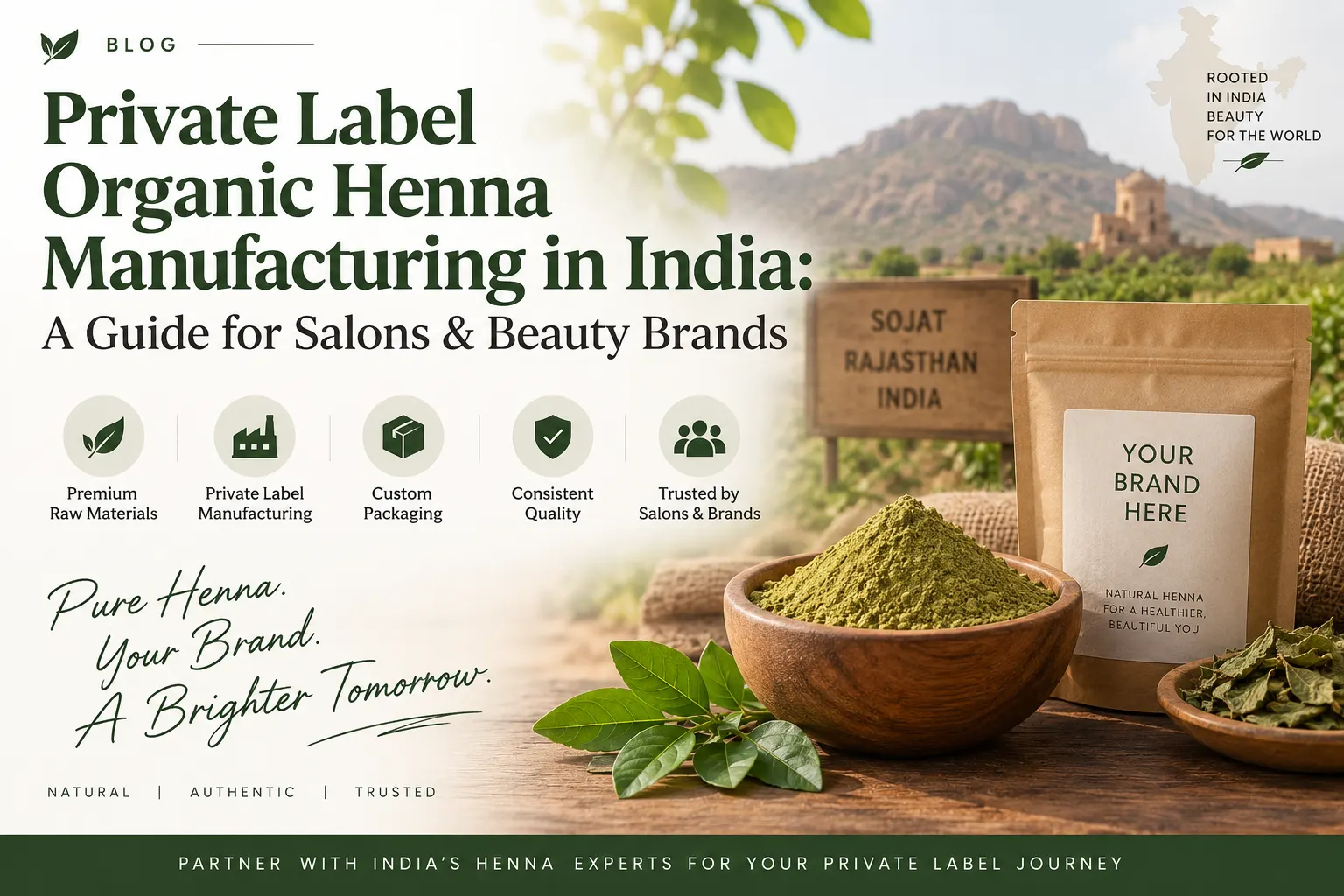
India has a well-established henna cultivation and processing ecosystem, with Sojat, Rajasthan remaining one of the country's most recognised regions for henna farming and production. For salons, beauty brands, wholesalers, distributors, and retailers seeking to introduce their own henna products, partnering with an experienced Indian manufacturer can provide access to bulk manufacturing, private label packaging, and a reliable supply of henna-based products.
A private label henna manufacturer in India can manufacture henna powder and associated herbal products under a buyer's own brand name, enabling businesses to develop their product portfolio without setting up their own manufacturing facility.
For businesses assessing suppliers, the main considerations extend beyond pricing. Raw material sourcing, processing practices, product consistency, testing, packaging, manufacturing capabilities, and order requirements all have an important role in selecting the right manufacturing partner.
Private label manufacturing enables a salon, beauty company, retailer, or distributor to market a product under its own brand instead of purchasing and reselling an established consumer brand.
For businesses entering the henna and herbal beauty market, this model can offer several advantages:
A private label arrangement can be particularly useful for salons and beauty businesses that already have an established customer base and want to introduce take-home products alongside their professional services.
However, private labeling should not be treated simply as putting a logo on a pouch. Product specifications, packaging requirements, quality expectations, production quantities, and documentation should be clearly discussed with the manufacturer before placing an order.
Choosing a suitable manufacturer is one of the most important steps when sourcing henna products for commercial use.
Different suppliers may have different approaches to sourcing, processing, testing, packaging, and production. Before selecting a manufacturing partner, businesses should evaluate the following areas:
|
Factor |
Why It Matters |
|
Raw material sourcing |
Helps establish the origin and consistency of the henna leaf |
|
Processing methods |
Proper drying, grinding and sieving influence powder quality and usability |
|
Product consistency |
Important for repeat orders and customer experience |
|
Quality testing |
Helps identify contaminants and verify relevant product specifications |
|
Manufacturing capability |
Determines whether the supplier can support the required volume |
|
Private label support |
Allows products to be sold under the buyer's own brand |
|
Packaging options |
Important for both retail presentation and bulk professional use |
|
Documentation |
Useful for maintaining product and procurement records |
|
Order flexibility |
Important for new brands and growing businesses |
|
Communication |
Clear specifications and timely coordination reduce supply issues |
A reliable supplier should be able to explain its manufacturing and quality processes clearly instead of relying only on generic claims.
Businesses can also review the manufacturer's broader sales and quality process to understand how product quality and commercial requirements are approached.
When researching Indian henna suppliers, buyers will frequently come across Sojat, Rajasthan.
Sojat and the surrounding region are well known for henna cultivation, processing, and trading. The region has developed a strong ecosystem around the crop, making it an important sourcing location for henna used in hair care, beauty applications, and body art.
Henna is obtained from the leaves of Lawsonia inermis. After harvesting, the leaves undergo drying and processing before being converted into henna powder.
One of the important quality characteristics buyers may consider is lawsone content, the naturally occurring pigment responsible for henna's characteristic staining and colouring properties.
However, geographic origin should not be treated as the only indicator of quality. The final product also depends on factors such as raw material selection, processing, fineness, storage, handling, and quality control.
For this reason, businesses sourcing henna in bulk should evaluate the manufacturer's complete production and quality process rather than choosing a supplier based only on the word "Sojat."
The quality of finished henna powder depends heavily on how the raw material is handled and processed.
While specific manufacturing procedures vary between manufacturers, commercial henna production generally involves several important stages, including:
For businesses interested in the production side, MaruHenna's henna manufacturing process provides a useful reference for understanding its manufacturing capabilities.
Private label and bulk sourcing are related but serve different business requirements.
|
Private Label Henna |
Bulk Henna Supply |
|
Product is sold under the buyer's brand |
Product is purchased primarily for bulk use or resale |
|
Branding and packaging are important |
Packaging may focus more on commercial handling |
|
Suitable for salons and consumer brands |
Suitable for wholesalers, distributors and professional users |
|
Requires coordination around labels and packaging |
Often prioritises quantity, consistency and supply |
|
Useful for building a dedicated product line |
Useful for maintaining regular inventory |
A business may also begin with bulk sourcing and later develop its own private label range once demand has been established.
The right model depends on the buyer's business structure, target customers, packaging requirements, expected volume, and long-term plans.
Henna manufacturing does not necessarily have to be limited to a single powder SKU.
Depending on the manufacturer's capabilities, businesses may source products such as:
A business can start with a core henna product and gradually expand its range based on customer demand.
For an overview of available product categories, buyers can explore MaruHenna's product range.
Salons are one of the natural markets for private label henna because they can use the product in professional services as well as offer it to customers for home use.
For example, a salon may create a branded henna product range for:
Beauty brands can also use private label manufacturing to develop products for their own distribution networks.
The advantage is that the brand can focus on marketing, distribution, customer relationships, and retail growth while the manufacturing partner manages the production side according to the agreed specifications.
Packaging is an important part of private label manufacturing because it affects product protection, presentation, storage, and customer perception.
Depending on the manufacturer's capabilities and the product, businesses may consider:
The appropriate format depends on whether the product is intended for salons, retail shelves, distributors, wholesalers, or direct-to-consumer sales.
For private label orders, buyers should discuss packaging material, pack size, printing requirements, labelling information, minimum production quantities, and lead times before confirming the order.
There is no single order quantity that works for every business.
The appropriate quantity depends on the type of buyer and the intended application.
A salon should first estimate its monthly professional consumption and expected retail sales. A wholesaler or distributor may instead calculate demand based on its customer network and distribution territory.
Before discussing an order with a manufacturer, consider:
Instead of selecting a quantity only because it is advertised as a standard MOQ, buyers should discuss their actual requirements with the manufacturer and determine whether the proposed quantity makes commercial sense.
For businesses selling or using henna professionally, consistency is critical.
A product that performs differently from one batch to another can create problems for salons, retailers, and distributors. Quality control should therefore be considered throughout the supply chain — from raw material sourcing to finished-product packaging.
Depending on the product and intended market, buyers may want to discuss:
Buyers should ask manufacturers what testing and documentation are available for the specific product being purchased rather than assuming that every henna product follows the same testing protocol.
MaruHenna provides further information about its approach to sales and product quality for businesses evaluating its supply capabilities.
The terms "natural," "organic," and "chemical-free" are frequently used in the henna market, but they should not automatically be treated as interchangeable.
A product described as natural may refer to its plant-based composition, while the term organic can also refer to a formal certification depending on the context.
For private label businesses, it is important to understand exactly what a manufacturer means by an "organic" claim and whether supporting certification or documentation applies.
Brands should also ensure that their own product packaging and marketing claims accurately reflect the documentation available for the product.
This becomes particularly important when creating a private label product intended for commercial distribution across different Indian markets.
India's established henna-growing and processing ecosystem gives domestic buyers access to manufacturers and suppliers with experience in sourcing, processing, packaging, and commercial distribution.
For a Pan-India business, working with an Indian manufacturer can also simplify communication, domestic logistics, product sampling, and replenishment compared with sourcing from an overseas supplier.
An experienced manufacturer can potentially support different types of buyers, including:
However, experience should always be evaluated alongside actual manufacturing capability, product quality, communication, and the supplier's ability to meet the buyer's specific requirements.
MaruHenna operates from the henna-producing ecosystem of Rajasthan and focuses on supplying henna products for businesses looking for consistent, commercially suitable products.
With an emphasis on natural henna and B2B supply, MaruHenna can serve businesses that need henna products for professional use, wholesale distribution, retail, or their own product range.
The company's capabilities extend beyond simply supplying raw henna powder. Buyers can explore its manufacturing capabilities to understand how production is handled.
For businesses evaluating a potential supplier, the MaruHenna About page also provides additional information about the company and its background.
Whether the requirement is for bulk henna, product sourcing, or a private label opportunity, specifications should be discussed directly so that the product, packaging, quantity, and commercial requirements can be aligned before production.
Before placing a commercial order, buyers should ask the manufacturer:
A clear discussion at this stage can prevent misunderstandings later and help both the manufacturer and buyer establish realistic expectations.
Launching a private label henna product does not necessarily require a business to build its own manufacturing infrastructure.
The basic process can involve:
Business Requirement → Product Selection → Manufacturer Evaluation → Sample/Specification Review → Packaging & Branding → Production → Quality Checks → Final Packaging → Distribution
The buyer's role is primarily to define the market, product requirements, branding, packaging, and commercial objectives. The manufacturing partner then produces the agreed product according to the final specifications.
For a new beauty brand, starting with a focused product range can often be more practical than launching too many SKUs at once. Once customer demand and repeat sales become clearer, the range can be expanded.
India has a long-established market for henna and herbal beauty products, supported by both domestic consumption and commercial manufacturing infrastructure.
For businesses operating across India, sourcing locally can provide practical advantages such as:
For businesses looking to build a private label product, the combination of domestic manufacturing and established henna sourcing can provide a practical foundation for entering or expanding within the herbal beauty market.
Private label henna manufacturing gives salons, beauty brands, wholesalers, distributors, and retailers an opportunity to develop their own branded henna products without establishing a manufacturing facility from the ground up.
For buyers across India, the right manufacturer should be evaluated on more than price or geographic origin. Raw material sourcing, processing, product consistency, quality control, packaging, manufacturing capability, order requirements, and communication all contribute to a reliable supply relationship.
Sojat and the wider Rajasthan region remain important to India's henna industry, but the quality of the finished product ultimately depends on how the raw material is processed, handled, tested, and packaged.
If you are looking for bulk henna supply, private label manufacturing, or commercial henna products in India, explore MaruHenna to learn more about its products, manufacturing capabilities, and B2B supply options.
For specific product requirements, packaging, or commercial enquiries, you can contact MaruHenna directly.
Private label henna manufacturing is a process in which a manufacturer produces henna or henna-based products that are sold under another business's brand name. The buyer can typically coordinate product specifications, packaging, branding, and order requirements with the manufacturer.
Yes. Salons can work with a manufacturer that supports private label production to develop branded henna products for professional use or retail sales. The exact product, packaging, branding options, and order requirements should be confirmed with the manufacturer.
Sojat and surrounding areas in Rajasthan are well known for henna cultivation, processing, and trading. The region has an established ecosystem supporting the production and supply of henna products.
Consider raw material sourcing, processing methods, product consistency, quality testing, packaging options, manufacturing capacity, private label support, documentation, order quantities, lead times, and communication.
Yes. Indian manufacturers and suppliers serve different B2B requirements, including bulk supply for salons, wholesalers, distributors, retailers, and other commercial buyers. The suitable quantity depends on the buyer's specific requirements.
Private label manufacturing can allow businesses to sell henna products under their own brand. Packaging, labelling, customisation, production quantities, and other requirements depend on the manufacturer's capabilities and the agreed specifications.
Depending on the manufacturer's capabilities, businesses may source natural henna powder, Sojat henna, henna-based products, henna oil, and other herbal or hair-care products.
Packaging should be selected according to the product's intended use, target customer, quantity, storage requirements, retail positioning, and distribution model. Businesses should discuss pack sizes, material, printing, labelling, and production requirements with the manufacturer.
Not necessarily. "Natural" generally describes the product's plant-based or naturally derived composition, while "organic" may refer to specific production standards or formal certification. Businesses should verify the exact basis of any organic claim before using it commercially.
Businesses can review MaruHenna's products and manufacturing capabilities and contact the company directly through its contact page to discuss product, packaging, quantity, and other commercial requirements