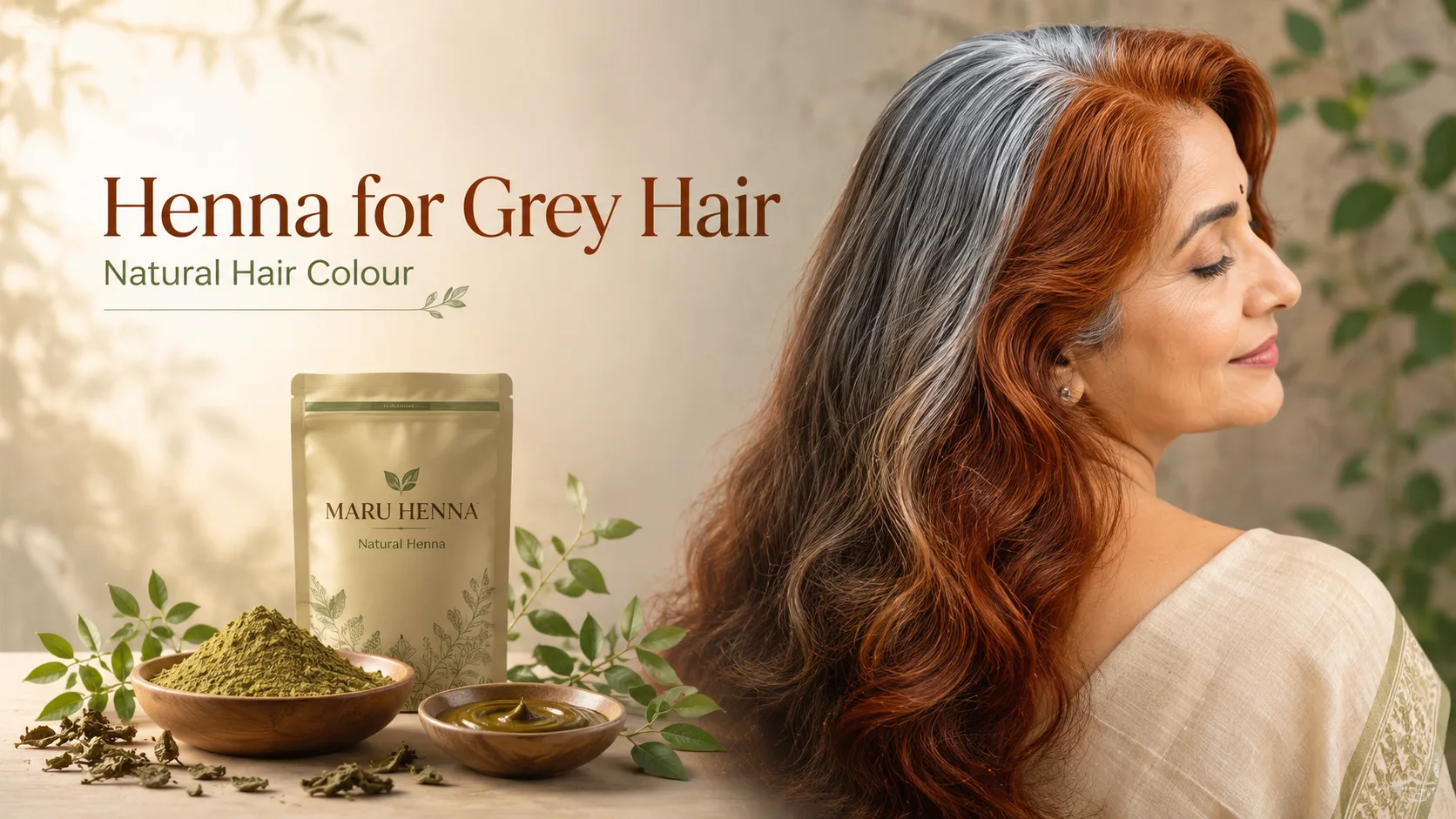
Grey hair is a natural part of ageing, but many people prefer to reduce its appearance without relying on conventional permanent hair dyes. This has increased interest in henna powder for grey hair as a plant-based approach to colouring and refreshing the appearance of grey strands.
Unlike oxidative hair dyes, pure henna does not bleach hair or chemically remove its natural pigment. Instead, its naturally occurring dye compound, lawsone, deposits colour onto the hair fibre and produces characteristic warm shades such as copper, reddish-brown and auburn.
For people searching for henna for grey hair naturally, understanding the expected result is important. Grey or white strands generally show the henna colour more brightly than dark hair. Pure henna can therefore create attractive copper or warm red tones, but it does not naturally produce an instant black colour.
In this guide, you will learn how to cover grey hair with henna, what affects the final colour, how to select quality henna powder, common mistakes to avoid, and how to choose a reliable henna supplier in India.
For a broader introduction to henna, you can also read our guide on henna powder for skin and hair.
Henna powder for grey hair is made from the dried and finely ground leaves of Lawsonia inermis, the botanical plant traditionally used for henna. Its primary colouring compound, lawsone, binds with keratin in the hair and creates the characteristic henna stain.
Grey hair contains little or no melanin, so it can display henna's colour more visibly than naturally dark hair. This is why pure henna applied to grey or white strands may appear copper, orange-red or warm auburn rather than simply brown.
For someone looking for natural grey hair coverage, the desired shade should be decided before application.
| Starting Hair Colour | Typical Pure Henna Result |
|---|---|
| White or very light grey | Bright copper to orange-red |
| Salt-and-pepper | Warm copper/red highlights with darker strands remaining darker |
| Medium brown | Warm auburn or reddish-brown tones |
| Dark brown or black | Subtle warm or reddish highlights |
If the goal is a deeper brown or black appearance, henna may be incorporated into a botanical colouring system using other plant-based colourants such as indigo. The final result depends on the formulation, application process and starting hair colour.
If you are learning how to cover grey hair with henna, start by deciding what colour you actually want.
For a warm copper, auburn or reddish appearance, pure henna can be an appropriate option. Prepare the powder according to the manufacturer's instructions, apply it evenly to clean hair, make sure grey areas are thoroughly coated and follow the recommended processing time.
A basic application process may include:
Preparation requirements can vary between henna products. Therefore, avoid assuming that every henna powder requires exactly the same mixing liquid, resting period or processing time.
For a more detailed general application guide, see our article on henna powder for skin and hair.
Not every product marketed as "natural henna" is necessarily identical. Check the ingredient declaration, manufacturer information, intended use and product specifications before purchasing.
Pure henna naturally produces warm colour tones. Products claiming to produce instant black colour should be investigated carefully because additional colouring ingredients may be present.
Someone with a small percentage of grey hair may get a significantly different visual result from someone whose hair is predominantly white. Grey and white strands can display henna much more brightly than dark strands.
Pure henna is generally associated with copper, red, auburn and warm brown tones. If your preferred result is a darker brown or black shade, a suitable botanical colour system may be more appropriate than pure henna alone.
Freshness, particle size, processing, filtering, packaging and storage can influence the consistency of a henna powder. A fine, properly processed powder is generally easier to mix and apply evenly.
For commercial buyers, these factors become even more important because batch consistency can directly affect the finished product.
Learn more about Maru Henna's quality assurance and supply process.
Do not automatically assume that longer processing produces a better result. Follow the specific instructions provided with your chosen product.
Even plant-derived ingredients can cause reactions in susceptible individuals. Follow the product's safety instructions and perform an appropriate patch test before full application.
If significant irritation, swelling, burning or another unexpected reaction occurs, discontinue use and seek appropriate medical advice.
When used appropriately, henna powder for grey hair offers several reasons why it remains popular among consumers and professional users.
Pure henna is derived from Lawsonia inermis and provides a botanical alternative for people interested in plant-derived hair colouring.
For people who prefer copper, auburn or reddish-brown shades, henna can create attractive tonal variation instead of a completely uniform artificial-looking colour.
Henna deposits colour over the existing hair rather than bleaching the natural pigment. As a result, the final appearance varies according to the starting shade.
Grey and white strands can take up the henna pigment visibly, creating noticeable warm highlights and helping blend grey hair with the rest of the hair.
Henna can be used as part of a botanical colouring approach when a deeper shade is required. Depending on the desired result, other plant-based dyes may be incorporated.
Consumers may purchase smaller quantities for personal use, while salons, retailers, cosmetic brands and distributors may require larger and more consistent supplies.
For commercial buyers, sourcing, harvesting, drying, grinding, filtering, quality control and packaging can all contribute to a more consistent finished product.
Maru Henna follows a farm-to-powder approach, sourcing henna from Sojat, Rajasthan, and processing it through cultivation, harvesting, drying, fine grinding and hygienic packaging stages.
Explore Maru Henna's natural henna powder for personal, wholesale and commercial requirements.
When searching for the best henna for grey hair, avoid judging a product only by its packaging or colour claims.
Instead, consider the following factors:
For consumers, consistency and ease of application may be the most important factors. For salons and businesses, additional considerations such as bulk availability, packaging options, batch consistency and long-term supply become increasingly important.
Maru Henna supplies natural henna powder sourced from Sojat and provides retail and bulk purchasing options through its henna powder shop.
The final henna hair color for grey hair depends on several factors, including the original hair colour, percentage of grey hair, hair porosity, henna quality, preparation and processing time.
Pure henna generally creates warm shades rather than cool or ash tones.
Common results include:
It is important to set realistic expectations. Pure henna does not naturally behave like a conventional permanent black hair dye.
Many disappointing results come from incorrect expectations or inconsistent application rather than from henna itself.
Pure henna naturally produces warm tones. If you want black hair, you need to investigate a suitable darker botanical colouring system rather than expecting pure henna to behave like synthetic black dye.
Henna works with the existing hair colour. The same powder can produce different results on white, blonde, brown and black hair.
Always check the ingredients and manufacturer information. Avoid products with unclear formulations or unexplained claims.
Grey areas should receive thorough and even coverage. Sectioning the hair can make the application more consistent.
Follow the recommended processing instructions instead of automatically increasing the application time.
The quality of a finished henna powder starts with the raw botanical material. Growing conditions, harvesting, drying, grinding, filtering, packaging and storage can all influence the finished product.
Sojat, Rajasthan, is an important henna-producing region, and Maru Henna sources its natural henna directly from Sojat farms.
The production process includes:
This farm-to-powder approach gives buyers greater visibility into how the raw material becomes the finished product.
Businesses interested in manufacturing standards and product consistency can visit Maru Henna Sales & Quality Assurance.
Consumers and businesses across India can source henna powder for personal and commercial applications. Maru Henna is based in Sojat, Rajasthan, and supplies natural henna powder to customers across India as well as international buyers.
Customers may include:
For consumers looking for smaller quantities, the Maru Henna online shop provides available retail and bulk pack options.
For businesses, larger-volume supply and customized packaging options can also be discussed with the manufacturer.
View available henna powder and bulk options.
Maru Henna is a manufacturer, supplier and exporter of natural henna powder sourced from Sojat, Rajasthan.
The company serves both B2C and B2B customers, including individual consumers, wholesalers, retailers, salons, cosmetic brands, distributors and international buyers.
Its manufacturing approach focuses on sourcing, controlled processing, fine grinding, quality inspection and hygienic packaging.
For businesses, Maru Henna also provides bulk supply, customized packaging, private-label support and export-oriented solutions.
Commercial buyers can explore bulk, packaging and private-label henna solutions available from Maru Henna.
Whether you are buying henna for personal grey hair coverage or sourcing raw material for a business, start with product quality, transparent ingredients and reliable sourcing.
Maru Henna provides natural henna powder sourced from Sojat, Rajasthan, with options for retail customers, wholesalers, salons, cosmetic brands and export businesses.
For product enquiries, wholesale requirements, private-label projects or export requirements:
Request a Bulk Henna Supply Quote →
Using henna powder for grey hair can be a practical option for people who prefer botanical hair colouring and want warm copper, red, auburn or reddish-brown tones.
The most important point is to understand how pure henna works. It deposits colour onto the hair rather than bleaching the existing pigment, which means grey strands can appear brighter than darker strands.
For deeper brown or black results, henna may be incorporated into a suitable botanical colouring system using other plant-based dyes. The final result depends on the formulation, starting hair colour and application process.
When choosing henna, focus on purity, freshness, ingredient transparency, manufacturing quality and realistic colour expectations.
If you are searching for henna powder for grey hair in India, Maru Henna provides Sojat-sourced natural henna for personal use, wholesale supply, private-label manufacturing and export requirements.