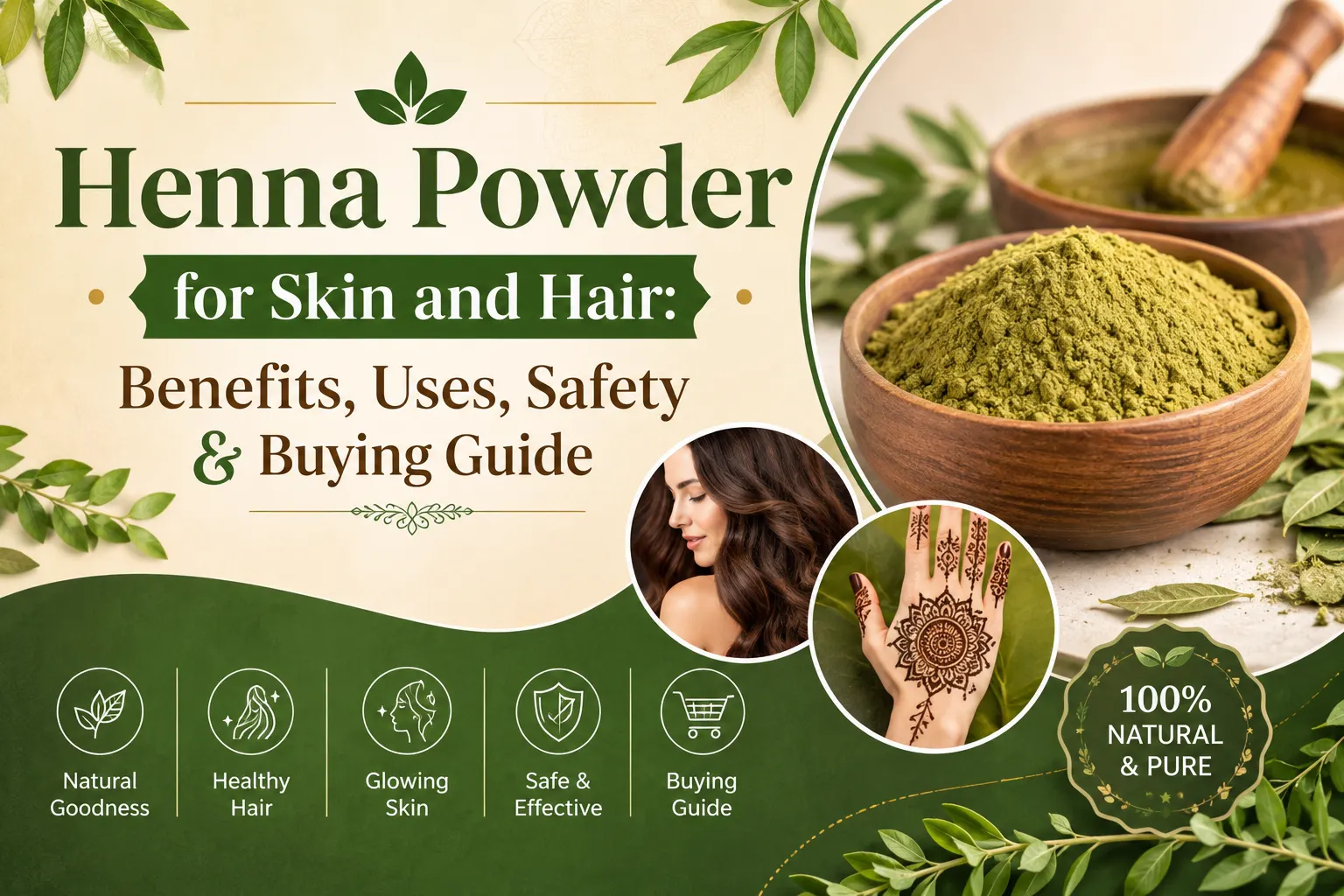
Henna has been used for centuries in traditional beauty, hair care, and body-art practices. Made from the leaves of the Lawsonia inermis plant, natural henna is best known for its ability to create warm copper, orange, red, and reddish-brown tones on hair and skin.
Today, interest in henna powder for skin and hair is growing as consumers, salons, cosmetic brands, and businesses look for plant-derived beauty ingredients.
The main coloring compound in henna is lawsone, a naturally occurring pigment that interacts with keratin and produces henna's characteristic stain. Scientific research has investigated Lawsonia inermis and its compounds for various biological properties, including antioxidant and antimicrobial activity.
However, it is important to distinguish between traditional cosmetic use, laboratory research, and clinically proven medical benefits. Natural henna is well established as a coloring ingredient, but it should not automatically be considered a treatment for hair loss, dandruff, infections, or other medical conditions.
The quality of henna powder also matters. Botanical source, harvesting, drying, grinding, sieving, packaging, storage, and manufacturing practices can all influence the final product.
For buyers interested in naturally sourced henna, Maru Henna offers natural henna powder sourced from Sojat, Rajasthan, along with wholesale, private-label, and export-oriented supply solutions.
In this complete guide, you'll learn about the benefits of henna powder for skin and hair, how henna works, how to use it, how to choose a quality product, the difference between natural and black henna, and important safety considerations.
Henna powder is produced by drying and finely grinding the leaves of the Lawsonia inermis plant.
The plant naturally contains lawsone, the primary dye compound responsible for henna's characteristic reddish-orange and brown staining properties.
When used on hair, the pigment interacts with keratin and produces a color that can range from copper and orange to red, auburn, and warm brown depending on the starting hair color and application process.
When used for traditional body art, natural henna typically produces an orange, reddish-brown, or brown stain rather than an instant black stain.
The final result can depend on several factors, including:
If you're specifically looking for natural henna, check the ingredient information and botanical identity.
Pure henna should be associated with Lawsonia inermis rather than an undisclosed mixture of synthetic colorants.
For cosmetic purchasing, ingredient transparency is just as important as attractive packaging or marketing claims.
Hair coloring is one of the most established cosmetic applications of henna.
For centuries, henna has been used as a plant-based hair colorant, and it remains popular among people who prefer botanical beauty products.
Here are some of the commonly recognized cosmetic and traditional benefits of henna powder for hair.
Henna is primarily known for its natural coloring ability.
The lawsone in henna interacts with keratin in the hair and creates warm tones. Depending on the starting hair color, the result may appear copper, orange-red, auburn, reddish-brown, or as warm highlights.
For example:
Henna does not behave like every conventional synthetic hair dye, so expectations should be based on the starting hair color and desired result.
Henna is often used as a traditional hair treatment because its pigment interacts with the hair shaft.
After application, some users find that their hair feels more substantial, coated, or fuller.
This is primarily a cosmetic effect.
It should not be confused with increasing the number of hair follicles or permanently repairing structural hair damage.
Individual experiences can vary depending on hair type, porosity, condition, and frequency of application.
Hair color and surface texture both influence the appearance of shine.
After a henna application, some people notice that their hair looks more vibrant and polished.
The coating and color effect can contribute to this appearance, particularly when the hair is already in relatively good condition.
However, results aren't identical for everyone.
Hair porosity, existing chemical treatments, product quality, and application technique can all influence the final appearance.
For people interested in botanical beauty routines, pure henna can provide a plant-derived alternative to certain conventional hair-coloring products.
One advantage of choosing a simple henna powder is that the ingredient list may be straightforward and easy to understand.
However, "natural" does not automatically mean that a product is suitable for everyone.
Consumers should still check the ingredient list, intended use, product instructions, and potential sensitivities before application.
Henna has a long history in traditional hair care.
Some people use it mainly for color, while others include it as part of a broader botanical hair-care routine.
It is important, however, to separate traditional use from medical claims.
Henna has a well-established history as a cosmetic colorant, but this does not establish it as a clinically proven treatment for hair loss or scalp disease.
One of the most common questions surrounding henna is whether it promotes hair growth.
The safest answer is:
There is insufficient clinical evidence to describe ordinary henna powder application as a proven hair-growth treatment.
Scientific research has examined Lawsonia inermis and its naturally occurring compounds, including various biological activities. However, laboratory findings should not automatically be interpreted as evidence that applying henna to the scalp stimulates human hair growth.
If you are experiencing persistent hair loss, sudden shedding, bald patches, or significant scalp irritation, it is better to identify the underlying cause with appropriate professional guidance rather than relying on henna as a treatment.
Henna and compounds found in Lawsonia inermis have been investigated for antimicrobial activity.
This scientific interest helps explain why henna has historically appeared in various traditional personal-care practices.
However, laboratory antimicrobial activity does not establish henna powder as a clinically proven treatment for dandruff.
Dandruff can have different causes and may require targeted treatment.
Therefore, henna is better viewed as a traditional cosmetic ingredient rather than a medically established dandruff treatment.
Henna has a particularly strong cultural history of use in traditional body decoration.
Its natural pigment produces temporary stains on the skin and has been used for mehndi and other forms of body art across many cultures.
Research has also investigated compounds from Lawsonia inermis for antioxidant, antimicrobial, and other biological activities.
However, laboratory findings should not be presented as proof that henna treats specific skin conditions.
The primary established cosmetic skin application of natural henna is temporary body decoration.
Henna is widely associated with mehndi and traditional body art.
A prepared henna paste can be applied to the skin in decorative patterns. As the stain develops, natural henna typically creates orange, red-brown, or brown shades.
The final color can change over time as the stain develops and oxidizes.
Henna leaves contain several naturally occurring compounds, with lawsone being particularly important for its coloring properties.
Scientific research has examined Lawsonia inermis and its phytochemical constituents.
This makes henna an interesting botanical ingredient from both traditional and scientific perspectives.
However, scientific interest should not be confused with proof of a medical treatment.
For people interested in traditional plant-based beauty practices, henna provides a culturally significant botanical ingredient.
Its most established cosmetic applications remain:
When purchasing henna for skin application, ingredient transparency is especially important.
The botanical source can be the same, but the intended application matters.
Natural henna comes from Lawsonia inermis, but products can differ in formulation, processing, labeling, and intended use.
|
Always check the specific product's label and intended use rather than assuming that every henna product is interchangeable.
Understanding the difference between natural henna and black henna is particularly important when using henna on the skin.
Pure henna comes from Lawsonia inermis.
Its natural pigment generally creates:
The exact shade depends on the application and the individual.
Natural henna does not normally produce an instant jet-black stain.
"Black henna" is a marketplace term often associated with products designed to create a darker and faster stain.
Some black henna products may contain p-phenylenediamine (PPD) or other additional coloring chemicals.
The U.S. Food and Drug Administration warns that certain products marketed as black henna may contain PPD, which can cause potentially serious skin reactions.
Therefore, anyone purchasing henna for body art should carefully check the ingredient information instead of assuming that every product labeled "henna" contains only natural henna.
Be particularly cautious when a product:
When in doubt, ingredient transparency should take priority over the promised color.
Natural henna has a long history of topical use, but no cosmetic ingredient should automatically be considered suitable for every person.
Safety depends on:
The greatest concern is often associated with products sold as black henna, particularly when they contain PPD.
Before using a henna product on a larger area, follow the manufacturer's instructions and consider appropriate skin-sensitivity precautions.
If significant irritation, swelling, blistering, or another unexpected reaction occurs, discontinue use and seek appropriate medical advice.
Preparation methods can differ between products, so the manufacturer's instructions should always take priority over generic recipes.
A basic hair application process may include the following steps.
Use an appropriate amount based on your hair length, thickness, and desired coverage.
Longer or thicker hair generally requires more powder.
Place the powder into a clean container and gradually add the recommended liquid.
Mix until a smooth, manageable paste is formed.
Different henna products can have different preparation requirements.
Avoid assuming that every henna powder needs the same resting period or mixing method.
Divide the hair into sections and apply the paste evenly.
Pay particular attention to the areas where you want consistent color coverage.
Keep the product on the hair according to the manufacturer's directions.
Leaving henna on for significantly longer does not necessarily produce a better result.
Rinse the hair carefully until the majority of the henna paste has been removed.
Allow the final color to develop according to the product instructions.
If you are using pure henna specifically for hair, a basic preparation can involve mixing the powder with the recommended liquid to create a smooth paste.
The paste can then be applied evenly to the hair and left according to the product's recommended processing time before thorough rinsing.
For first-time users, keeping the formulation simple can be useful.
Adding many unfamiliar ingredients simultaneously can make it difficult to determine which ingredient is responsible for a reaction or an unwanted result.
If you intend to use henna for body art, select a product specifically intended for that purpose and verify its ingredients before application.
A traditional process generally involves:
Natural henna generally produces orange, red-brown, or brown shades.
If a product promises a very dark or black stain extremely quickly, investigate its ingredients carefully before applying it to the skin.
Not every henna powder provides the same experience.
The quality of the final powder can be influenced by the plant material, growing conditions, harvesting, drying, grinding, filtering, packaging, and storage.
When choosing henna powder for skin and hair, consider the following.
Look for Lawsonia inermis when purchasing true natural henna.
A clear botanical identity makes it easier to understand what the product actually contains.
Do not rely exclusively on terms such as:
Instead, check the actual ingredient information.
Determine whether the product is intended for:
The intended use should be clearly communicated by the manufacturer.
A reliable supplier should be able to explain important aspects of its sourcing and processing.
For business buyers, information about manufacturing, packaging, quality control, and supply capacity can be particularly valuable.
A finely processed powder can be easier to mix and apply consistently.
Fine particle size can also contribute to a smoother paste.
Henna powder should be protected from:
Appropriate packaging can help maintain product freshness and consistency.
For personal use, supplier transparency is helpful.
For salons, cosmetic brands, retailers, wholesalers, and exporters, it becomes even more important.
A reliable supplier should be able to provide clear information about the product, packaging, quantities, and supply arrangements.
Two henna powders can look similar while producing different results.
Factors that may influence quality include:
For individual consumers, these differences may influence color, texture, preparation, and ease of application.
For businesses, consistency can be even more important.
A salon or cosmetic manufacturer may need predictable results from one batch to another.
A wholesaler or exporter may additionally require:
This is why choosing a henna supplier should involve more than comparing price per kilogram.
For consumers and businesses looking for naturally sourced henna, Maru Henna is a manufacturer, supplier, and exporter based in Sojat, Rajasthan.
The company states that its henna is sourced directly from Sojat farms and processed through stages including cultivation, harvesting, natural drying, fine grinding, filtering, and hygienic packaging.
Maru Henna serves several types of buyers, including:
The company's website also presents dedicated information about manufacturing, quality assurance, wholesale supply, OEM/private labeling, and export supply.
For consumers:
Explore Natural Henna Products
For businesses:
Explore Wholesale & Bulk Henna Supply
For brands:
Learn About Private-Label & OEM Henna Solutions
For international buyers:
Explore Export-Ready Henna Supply
The Maru Henna website identifies its location as Sojat, Rajasthan, and provides contact information for buyers interested in product and bulk-supply inquiries.
One of the most important considerations when purchasing natural henna is understanding how the raw material becomes the finished powder.
Maru Henna describes its process in four broad stages:
Henna plants are cultivated in the Sojat region of Rajasthan.
Henna leaves are harvested with attention to preserving their natural dye content.
The leaves are dried and finely ground to produce a smooth powder.
The finished powder is hygienically packaged to help maintain freshness and consistency.
This farm-to-powder approach provides buyers with greater insight into the journey of the raw botanical material.
Natural henna is used by more than individual consumers.
Different buyers can have different requirements.
Personal buyers may prioritize:
Professional users may prioritize:
Brands may need:
Commercial buyers may look for:
Maru Henna states that it provides bulk supply, customized packaging, private-label support, and export-oriented solutions for business buyers.
A balanced understanding of henna is important.
Understanding these limitations helps consumers make better purchasing decisions.
Henna has a long history of use for natural hair coloring and traditional body art. Whether a particular product is suitable for both applications depends on its formulation, labeling, ingredients, intended use, and applicable regulations.
The primary cosmetic benefit is natural hair coloring. Henna can create copper, red, auburn, and warm brown tones. Some users also experience a fuller or coated feel after application.
Henna is traditionally used for temporary body decoration. Its naturally occurring compounds have also been studied scientifically, but research findings should not be interpreted as proof that henna treats specific skin diseases.
There is currently insufficient clinical evidence to describe ordinary henna application as a proven hair-growth treatment.
Henna compounds have demonstrated antimicrobial activity in laboratory research, but this does not establish henna powder as a clinically proven dandruff treatment.
Yes, henna can color gray or white hair. Because gray hair contains less natural pigment, the result may appear more visibly copper, orange, or red than it does on dark hair.
Henna may make individual strands feel more coated or substantial after application. This should not be interpreted as increasing hair follicle count or permanently increasing biological hair density.
No. Natural henna comes from Lawsonia inermis and generally produces orange, red, copper, or brown tones. Black henna products may contain additional chemicals such as PPD.
Yes. Products marketed as black henna may contain PPD, which can cause potentially serious skin reactions.
There is no universal frequency. It depends on your hair condition, desired color, product instructions, and how your hair responds to repeated applications.
Check the botanical identity, ingredient list, intended use, manufacturing information, powder quality, packaging, storage instructions, and supplier transparency.
No. Natural ingredients can still cause individual sensitivities or reactions. Product purity and intended use also matter.
Maru Henna states that its henna is sourced directly from farms in Sojat, Rajasthan, a region known for henna production.
Yes. Maru Henna states that it supplies bulk henna to wholesalers, distributors, retailers, cosmetic manufacturers, and international buyers.
Yes. The company states that it offers private-label and customized packaging solutions for business customers.
Henna powder for skin and hair remains popular because it combines traditional beauty practices with the appeal of a plant-derived coloring ingredient.
For hair, natural henna is primarily valued for its ability to create warm copper, red, auburn, and brown tones. It can also give some users a fuller or conditioned feel after application.
For skin, henna has a long cultural history of use in traditional body art and temporary decoration.
The plant's principal dye compound, lawsone, has been studied extensively, and scientific research has explored several properties of Lawsonia inermis. However, scientific findings should always be interpreted carefully. Traditional use and laboratory research do not automatically establish a product as a medical treatment.
For this reason, the best approach is to focus on what henna is genuinely well known for: natural coloring, traditional beauty use, and botanical personal-care applications.
Product quality is equally important.
Before buying, look for clear botanical identification, transparent ingredients, appropriate processing, suitable packaging, and a supplier that provides meaningful information about its products.
If you're looking for naturally sourced henna from Sojat, Rajasthan, Maru Henna provides natural henna powder along with wholesale, private-label, and export-oriented supply options.
For personal use, explore the Maru Henna website.
For wholesale, private-label, or export requirements, contact Maru Henna through the official website.